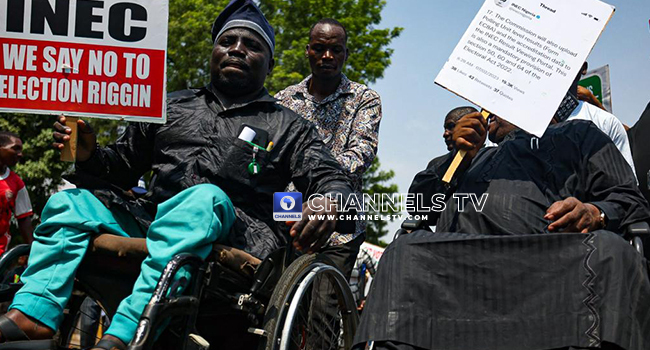
ADC Leaders Spearhead Protest At INEC HQ As Pro-INEC Group Counters Protest
By Time.com.ng Investigative Desk
Abuja — Nigeria’s political temperature rose sharply this week as leaders of the African Democratic Congress (ADC) staged a high-profile protest at the headquarters of the Independent National Electoral Commission (INEC), triggering a counter-narrative from pro-INEC voices who dismissed the demonstration as politically motivated.
The Protest: A Coalition of Heavyweights
On April 8–9, 2026, a coalition of opposition heavyweights led by David Mark, Atiku Abubakar, and Peter Obi converged on INEC headquarters in Abuja under the banner #OccupyINEC.
They were joined by influential figures including Rotimi Amaechi, Rauf Aregbesola, and Rabiu Kwankwaso, signaling what analysts describe as a rare alignment of Nigeria’s fragmented opposition.
The protest drew hundreds—possibly thousands—of supporters who marched through Abuja, chanting slogans against alleged electoral bias and warning against what they described as an emerging “one-party state.”
Core Allegations Against INEC
At the heart of the protest lies a deepening dispute between the ADC and INEC over party leadership recognition.
INEC had reportedly refused to recognise correspondence from rival ADC factions following a Court of Appeal ruling—effectively freezing the party’s internal legitimacy in the eyes of the electoral body.
ADC leaders escalated the confrontation by issuing a six-point demand, the most dramatic being the resignation or removal of INEC Chairman, Professor Joash Amupitan.
The party accused INEC of:
- Partisanship and political bias
- Interference in internal party affairs
- Overstepping constitutional boundaries by interpreting court rulings
One protest statement argued that INEC was acting as “arbiter, judge, accuser and defender at the same time,” a claim that underscores the opposition’s growing distrust of the electoral umpire.
Beyond ADC: A Wider Political Signal
What began as an intra-party dispute has evolved into something larger—a symbolic battle over Nigeria’s democratic future ahead of 2027.
Observers note that the protest quickly transformed into a broad coalition rally, with participants from multiple political movements joining forces.
Public messaging from figures like Peter Obi framed the protest as a defense of democracy itself, warning Nigerians against political consolidation under a single dominant party.
The Counter-Protest Narrative: Pro-INEC Pushback
While the ADC-led protest dominated headlines, pro-INEC voices and ruling party figures pushed back strongly.
Leaders within the ruling All Progressives Congress (APC) dismissed the protest as:
- A distraction from ADC’s internal crisis
- Evidence of opposition disorganization
- A sign that opposition parties are “unfit to govern”
APC National Chairman Nentawe Yilwatda reportedly mocked the protest, arguing that parties unable to manage internal disputes cannot be trusted with national leadership.
Additionally, pro-INEC sentiments—reflected in commentary and media narratives—frame the commission as:
- Upholding court decisions
- Maintaining neutrality amid factional disputes
- Being unfairly targeted by political actors ahead of elections
Inside the ADC Crisis
Ironically, even as protests raged, David Mark sought to downplay internal tensions within the ADC, insisting there was “no cause for alarm.”
This dual messaging—public protest versus internal reassurance—raises critical questions:
- Is the protest about INEC, or ADC’s internal legitimacy battle?
- Is the opposition consolidating, or masking fragmentation?
Security, Strategy, and Timing
The protest’s execution also revealed strategic undertones:
- It was reportedly rescheduled after earlier security pressure
- The eventual turnout appeared spontaneous and caught authorities off guard
- Despite heavy political tension, the demonstration remained largely peaceful
The timing—more than a year before the 2027 elections—suggests an early positioning battle rather than a reactive protest.
Investigative Analysis: What This Really Means
This confrontation is less about a single protest and more about three converging political dynamics:
1. INEC’s Legitimacy Under Scrutiny
For perhaps the first time since the 2023 elections, INEC faces a multi-party credibility challenge, not just isolated criticism.
2. Opposition Realignment Ahead of 2027
The presence of Atiku, Obi, Kwankwaso, and Amaechi in one protest signals a potential mega-coalition in formation—with ADC as its platform.
3. Narrative War: Democracy vs. Stability
- ADC frames the issue as a fight against authoritarian drift
- Pro-INEC/APC voices frame it as opposition desperation
This battle of narratives may define Nigeria’s next electoral cycle.
Conclusion
The ADC protest at INEC headquarters is not an isolated political event—it is a preview of the संघर्ष (struggle) for Nigeria’s democratic soul heading into 2027.
With opposition forces mobilising early and the electoral umpire under renewed scrutiny, Nigeria appears to be entering a phase where:
- Protests may become campaign tools
- Institutions may become battlegrounds
- Public perception may matter as much as legal rulings
Whether this marks the rebirth of a strong opposition—or the escalation of political instability—will depend on what happens next between ADC, INEC, and the ruling establishment.