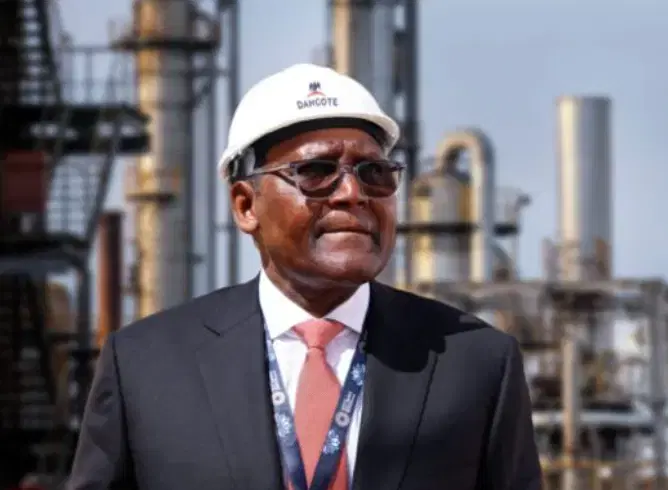
In August 2026, the Dangote Refinery secured a $1 billion underwriting for its upcoming stock market listing, set to become Africa’s largest IPO . This financial milestone is merely the latest signal of a profound structural shift underway: Nigeria is emerging as an industrial powerhouse that could fundamentally reshape the African economy—and it could happen sooner than many expect.
The Dangote Catalyst: Ending “Economic Slavery”
For decades, Africa’s largest oil producer endured a paradox that Femi Otedola, a Nigerian billionaire, has called “economic slavery” . Nigeria imported as much as 90% of its refined fuel despite sitting atop vast crude reserves, draining foreign exchange and exposing the economy to global price volatility . The state-owned refineries in Port Harcourt, Warri, and Kaduna—subject to repeated rehabilitation efforts and billions of dollars in spending—remained largely dormant .
The Dangote Refinery, with its 650,000 barrel-per-day capacity, has flipped this equation dramatically . Backed by Afreximbank’s $2.5 billion commitment—the largest share of a $4 billion syndicated loan—the refinery has begun supplying not just Nigeria but neighbouring markets across West, Central, and East Africa . In June 2026 alone, Nigeria shipped 466,000 tonnes of jet fuel to Europe, overtaking the United States as the continent’s top supplier .
This is not merely a trade statistic. It represents a structural declaration that Africa can refine its own resources and reshape global supply chains . As energy analyst Adedayo Ojo put it: “This proves, among other things, that intra-African trade is viable. Intra-African refined products are viable, and African countries and African companies producing world-quality products can actually bypass those that have previously dominated the market” .
The Fertiliser Link: Protecting Food Sovereignty
The refinery’s impact extends beyond fuel. Afreximbank previously financed the Dangote Fertiliser Plant, now Africa’s largest facility producing granulated urea . In its 2025 performance report, the Nigeria Export Promotion Council reported that urea was the country’s second-largest export earner, with total receipts of $1.29 billion .
This industrial synergy has become strategically vital. The war in Iran and the closure of the Strait of Hormuz—through which up to a quarter of global oil trade passes—have disrupted fertiliser markets worldwide . For Africa, which imports nearly 70% of its fertiliser, much of it routed through the Middle East, such disruptions threaten planting seasons and food production . The Dangote complex now serves as a continental shock absorber, reducing Africa’s exposure to Middle Eastern supply disruptions and softening the inflationary impact of global fuel price spikes .
An Industrial Ecosystem in the Making
The refinery’s catalytic potential extends far beyond its immediate operations. History offers instructive examples: Rotterdam grew into one of Europe’s largest industrial and logistics centres because refining attracted shipping, storage, chemicals, and manufacturing. Singapore transformed itself into a leading petrochemical hub by integrating refining with ports, logistics, finance, and advanced manufacturing .
Nigeria now has a similar opportunity. Around the Dangote complex, manufacturers can establish operations with access to ocean ports, power, water, and road facilities . The Lekki-Ogun-Ondo corridor could become a global industrial destination, attracting manufacturers to set up world-class production plants . As one analyst observed: “Rather than viewing the refinery as the end of an investment journey, policymakers should regard it as the beginning of a much larger industrial revolution” .
The Policy Foundation: Industrial Policy 2025-2035
The Nigerian government has recognised this moment. The Industrial Policy 2025-2035 represents the country’s most coherent industrial strategy in decades, premised on the understanding that “sustainable national prosperity cannot rest indefinitely on hydrocarbons and consumption-driven growth, but must instead be anchored in large-scale domestic production” .
The policy’s ambitions are striking. Manufacturing currently contributes less than 9% of GDP, compared with 15-20% in successful peers like Vietnam, Indonesia, and Thailand . The plan targets raising manufacturing’s GDP contribution to 15% by 2030 and 25% by 2035 . To achieve this, the federal government has pledged to allocate up to 5% of annual GDP—approximately $20 billion—toward industrial development instruments, including recapitalising the Bank of Industry to expand its lending capacity to nearly ₦3 trillion .
The policy is aligned with the African Continental Free Trade Area (AfCFTA), positioning Nigerian manufacturers to compete across the continent . As Dr. Muda Yusuf of the Centre for the Promotion of Private Enterprise noted, “Industrial policy provides a strategic direction, but competitiveness is what delivers economic transformation” .

The Challenges: Why “Sooner Than Later” Is Critical
Despite these developments, Nigeria faces formidable obstacles that could delay or derail this transformation . Unreliable electricity supply—averaging just 4,500 megawatts for a nation of over 200 million people—forces manufacturers to spend more on generating their own power than on core production activities . As Aliko Dangote himself emphasised: “Power means growth. No power, no growth” .
High logistics costs, expensive financing, regulatory bottlenecks, and policy uncertainty continue to erode competitiveness . The Manufacturers Association of Nigeria has highlighted the closure of more than 760 firms in 2023 and further job losses in 2024 . The persistent deindustrialisation has puzzled economists for decades: Nigeria possesses abundant natural resources, a vast domestic market, and a strategically advantageous geographic position, yet structural constraints have repeatedly undermined industrial momentum .
The AfCFTA Opportunity
The Africa Trade Report 2026 provides crucial context for understanding why Nigeria’s industrialisation could happen faster than expected. Africa’s merchandise trade expanded to approximately $1.5 trillion in 2025, while intra-African trade grew by 5.5% to about $213.8 billion . More importantly, the structure of that trade is changing: African countries are trading significantly more value-added goods and services among themselves .
“Unlike Africa’s exports to extra-African countries, which remain dominated by primary commodities, intra-African trade now accounts for a larger share of manufactured and processed goods,” the report notes . The AfCFTA is accelerating this shift, creating a continental market of 1.4 billion people that increasingly demands locally produced, refined, and manufactured goods.
For investors, the message is clear: “Africa is no longer simply a destination for resource extraction but is increasingly becoming a destination for value creation” . Geopolitical disruptions—supply chain diversification, re-emerging industrial policies, and strategic competition reshaping investment flows—should be viewed not merely as risks but as opportunities for Africa to position itself as an influential participant in global trade and industrial production .
The Ownership Question: Democratising Industrial Wealth
The Dangote Refinery’s planned IPO represents another transformative dimension. It offers an opportunity to democratise ownership of one of Africa’s most strategic industrial assets . For decades, Nigerians have participated in the petroleum sector largely as consumers. A public listing creates the possibility for citizens, pension funds, insurance companies, and other institutional investors to participate as owners of productive assets .
As one analyst observed: “Countries build wealth when their citizens own productive enterprises rather than simply consume their outputs. Capital markets become engines of development when they channel long-term savings into industries that create value, jobs and exports” . A successful listing would deepen Nigeria’s capital market while sending a powerful signal that world-class industrial assets can be built, financed, and publicly owned from within Africa .
Why This Could Happen Sooner Than Later
Several factors suggest Nigeria’s industrial transformation could accelerate more rapidly than conventional wisdom assumes:
First, the Dangote complex is already operational and expanding. Unlike previous industrial strategies that remained on paper, this anchor investment is producing real outputs, generating revenues, and creating an ecosystem around it .
Second, global disruptions are creating windows of opportunity. The war in Iran and supply chain fragmentation have increased demand for regionally refined products and fertilisers, positioning Nigeria as an alternative supplier .
Third, intra-African trade is growing structurally, not cyclically. The AfCFTA, combined with improving logistics and payment systems like PAPSS, is making it easier for Nigerian manufacturers to access continental markets .
Fourth, the Industrial Policy 2025-2035 has secured unprecedented financing commitments, with up to $20 billion annually pledged toward industrial development . Implementation, not resources, is the primary challenge.
Fifth, Nigeria’s demographics demand urgency. With a population projected to exceed 300 million by 2050 and 4-5 million young Nigerians entering the labour market each year, industrialisation is not merely an economic aspiration but a social and political necessity .
Conclusion: A Turning Point
The Bloomberg podcast episode that inspired this analysis captured the essence of the moment: Joe Studwell, author of How Africa Works, is optimistic that the seeds of sustained development are increasingly taking root, at least in some countries . Studwell argues that African countries have often failed to adopt development strategies that mirror Asian counterparts, but Nigeria—with the Dangote refinery, the new industrial policy, and the AfCFTA—may be charting a different course .
The refinery’s growing influence is now so significant that it is shaping pricing conversations, import policies, and competition across Nigeria’s downstream oil sector . Yet concerns about market concentration are valid, and the debate over whether to protect local industrial champions or prioritise open competition will intensify .
What is clear is that Nigeria has an opportunity to pursue a path similar to Rotterdam, Singapore, and Saudi Arabia’s Jubail Industrial City—where large-scale refining and petrochemicals anchor downstream industries producing plastics, fertilisers, engineering products, and export goods . The question is whether Nigeria can overcome the infrastructure deficits, policy inconsistencies, and financing bottlenecks that have historically derailed such ambitions .
As Aliko Dangote reminded policymakers: “If there is no protection, no industry will thrive here” . But protection alone is insufficient. What Nigeria needs is a competitive environment where reliable power, efficient logistics, affordable finance, and predictable policy enable manufacturers to compete not just domestically but across Africa and beyond.
The foundations are being laid. The question is whether the superstructure will follow—and whether it will happen soon enough to reshape the African economy before the window of opportunity closes.