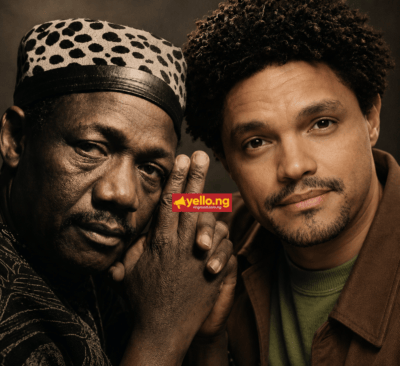
Trevor Noah and “Papa’s Land”
Trevor Noah has often spoken about growing up under apartheid. His autobiography, Born a Crime, explains that because his father was Swiss and his mother was Black, his very existence violated apartheid laws. His childhood was shaped by racial discrimination.
That history understandably leads many people to ask why he has not been more vocal during the latest wave of xenophobic hostility toward African migrants.
However, it is not entirely accurate to say he has been silent.
Recent reports indicate that Noah has discussed the current anti-immigrant crisis on his podcast, arguing that economic hardship and government failures are being redirected toward migrants as scapegoats rather than addressing the underlying causes. He reportedly described the hostility as a “misplaced priority” and argued that resource scarcity encourages people to blame outsiders instead of demanding better governance.
That said, some critics argue his comments have been less forceful or less visible than those of other public figures, especially given his global influence.
What is happening in South Africa?
Recent weeks have seen one of the largest anti-immigrant mobilizations since the 2008 xenophobic attacks.
Migrants from Nigeria, Zimbabwe, Malawi, Mozambique and several other African countries have reported intimidation, assaults and displacement. Thousands have sought assistance returning home, while the South African government has condemned vigilantism but also increased immigration enforcement.
Researchers and economists generally argue that migrants are not the primary cause of South Africa’s unemployment or poor public services. They instead point to factors such as:
- unemployment exceeding 30%
- corruption
- slow economic growth
- inequality
- weak public administration
These issues predate the current migration debate.
Should Nigerians call for MTN, Shoprite and other South African companies to leave Nigeria?
This is ultimately a political and economic question rather than one with a single factual answer.
Arguments for economic retaliation include:
- applying pressure on South African political leaders
- expressing solidarity with Nigerians facing attacks
- using consumer boycotts as a non-violent form of protest
Arguments against include:
- companies like MTN Group and Shoprite Holdings employ tens of thousands of Nigerians directly and indirectly
- many Nigerian pension funds and investors own shares in these companies
- many businesses operating in Nigeria are managed primarily by Nigerians
- retaliation could harm Nigerian workers more than South African policymakers
Many economists would therefore distinguish between:
- protesting government policies, and
- targeting private companies employing local workers.
What might Sonny Okosun have said?
Since Sonny Okosun died in 2008, no one can know with certainty.
However, based on his music—especially songs supporting African liberation and opposing apartheid—it is reasonable to think he would likely have condemned violence against fellow Africans while also urging African unity rather than hatred between nations.
His work consistently emphasized Pan-African solidarity instead of division.
The broader irony
Many Africans supported South Africa during the anti-apartheid struggle through sanctions, diplomacy, fundraising and political activism.
That history is why xenophobic attacks against fellow Africans generate such strong emotional reactions today. Critics argue that targeting fellow Africans contradicts the ideals of African solidarity that helped isolate apartheid internationally.
At the same time, it is important not to treat all South Africans as sharing the same views. Many South Africans—including religious groups, civil society organizations, journalists and ordinary citizens—have publicly condemned xenophobic violence and defended migrants.
Recently
Fire in “Soweto “
Police have cordoned off a section of Barbara Road in Klopper Park, Germiston, where a group of demonstrators are moving from one company’s premises to another.
The protesters claim they are targeting businesses they believe are employing foreign nationals instead of South Africans.
Police have described the situation as highly volatile and are maintaining a strong presence in the area.
The group is believed to have been involved in violent incidents on Monday, prompting heightened monitoring by law enforcement amid concerns that further violence could erupt.
The demonstrators are singing and carrying sticks as they march, while members of the police and the Ekurhuleni Metropolitan Police Department continue to monitor the situation closely to prevent any escalation.
Police say some of the demonstrators tried to go into people’s houses looking for foreign nationals, but were prevented by police. There were reports of violent protest action and looting in this area last night, and police are monitoring the situation closely.